The Incident in the Yukon
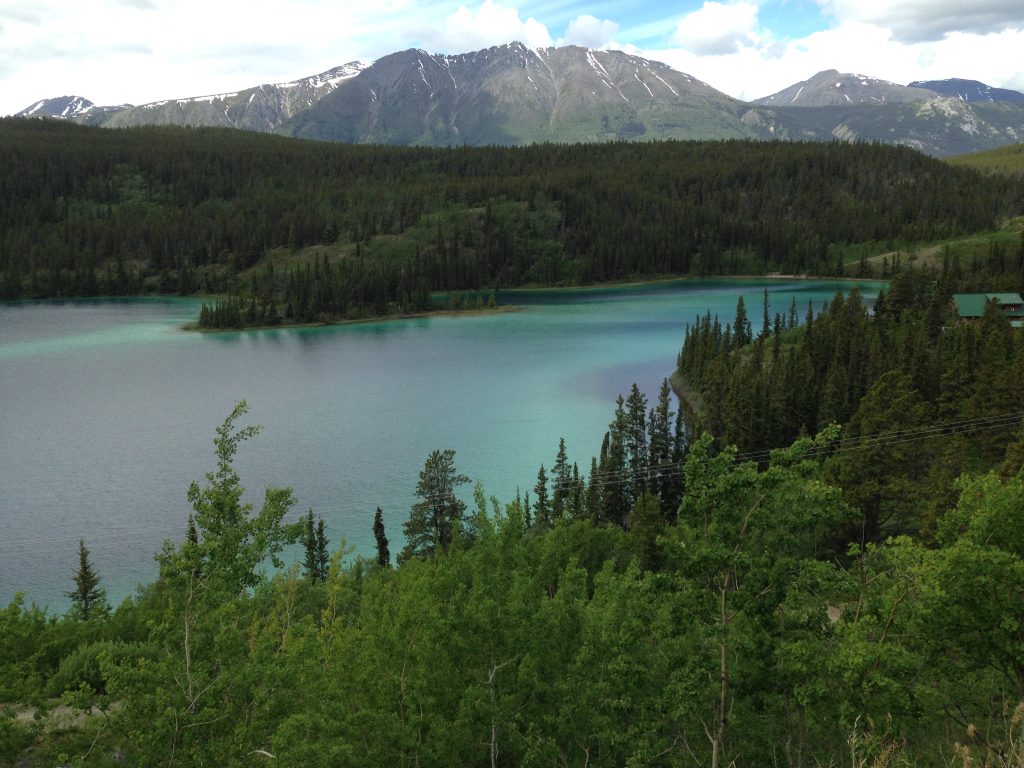
There are times in the life of professional P.R. guy when you are asked to do something mundane — escort a small press group — to someplace exotic — The Yukon — and you end up having a truly once-in-a-lifetime experience. Such was the trip I hosted with four travel journalists for Holland America Line in 2016.
The junket was intended to expose our small press group to the experience Holland America guests would have on one of their Alaska cruisetours, so we traveled by bus, train, plane and SUV to reach the nearer reaches of Canada’s Yukon Territory.
We went to Fairbanks for an overnight at a Holland America hotel where we were treated to a traditional burlesque show at the Palace Theater that was one of the most entertaining live performances I’ve ever seen. It consisted of bits of history interspersed with slapstick comedy, songs from the Gilded Age, can-can dancers, a half-dozen people playing a tune on saws with violin bows and, for the finale, a live-action, dramatic re-enactment of the poem “The Cremation of Sam McGee” by Robert W. Service.
Then it was northward by SUV to Dawson City — the jumping-off point for the Klondike Gold Rush of 1896 to 1899.
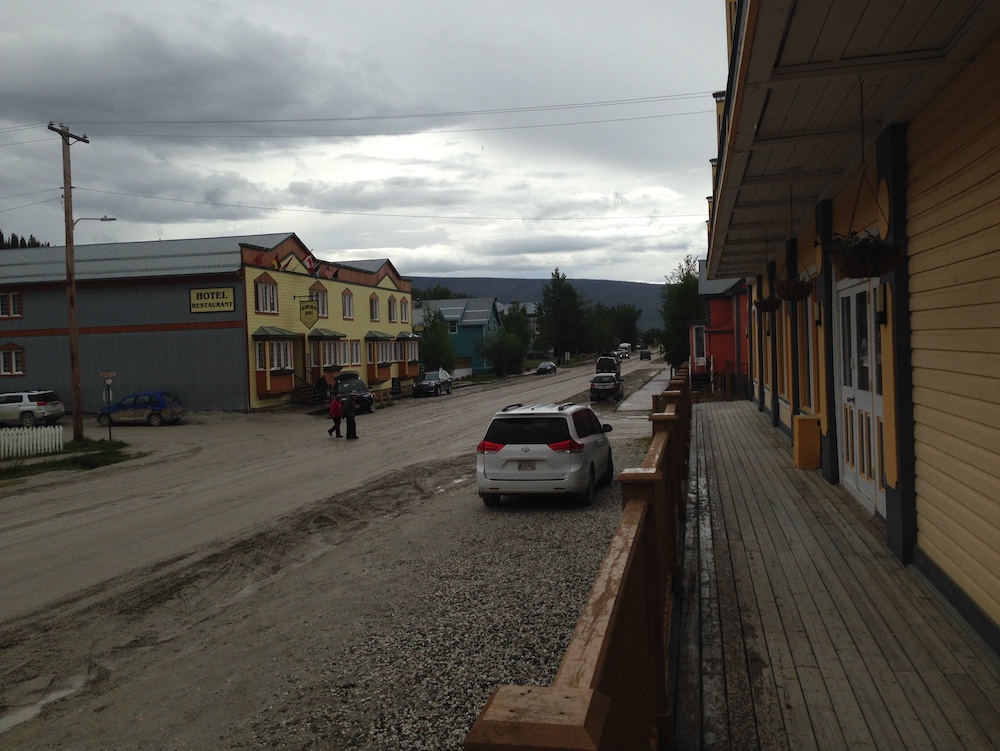
The Streets of Dawson City.
Dawson City still looks much like it did a century ago — unpaved streets, raised wooden sidewalks and wood-facade buildings that looked like a set in a Clint Eastwood western. Of course, it was the summer, so it never really got dark in the Great Northwest. At 2 o’clock in the morning it looked like an overcast day outside, which was disruptive to a native Floridian’s diurnal clock.
I got to explore Dawson City on my own and, as an English major, was keen to visit the former homes of Jack London, author of “The Call of the Wild,” and the aforementioned Robert Service, whose collection of poems, “It Takes a Heap ‘O Living to Make a House a Home” was one of the few literary tomes in my childhood home. I had even memorized “Sam McGee” for a sixth-grade recital. I found it passing strange that tiny Dawson City had been inhabited by two towering figures of popular literature of the early 20th century.
Our three nights in Dawson City were spent at various watering holes, which is how we found ourselves in the Downtown Hotel one evening, seriously considering the prospect of ingesting a Sourtoe Cocktail.
Legend has it that a pickled toe, lost by a miner to frostbite, came into the possession of one Captain Dick, though the actual provenance remains (probably purposefully) murky. And so a tradition was born, that whosoever dared could experience a Sourtoe Cocktail for US$10 (CA$13.25). Of course, you had to supply the liquor.
So, I bellied up to the bar and informed the bartender that it was my intention to have a Sourtoe and asked for a recommendation of a fine Canadian rye whiskey. It was here that I ran smack into one of the greatest disparities between the United States and our neighbors to the north: in the U.S., when you order a shot, you get a 2-ounce pour, but in Canada, a shot is a single, measured ounce. So when the barkeep placed a glass in front of me containing a pitiful amount of amber liquid, I said, “That doesn’t look like enough liquor to float a toe, so please make it a double.”
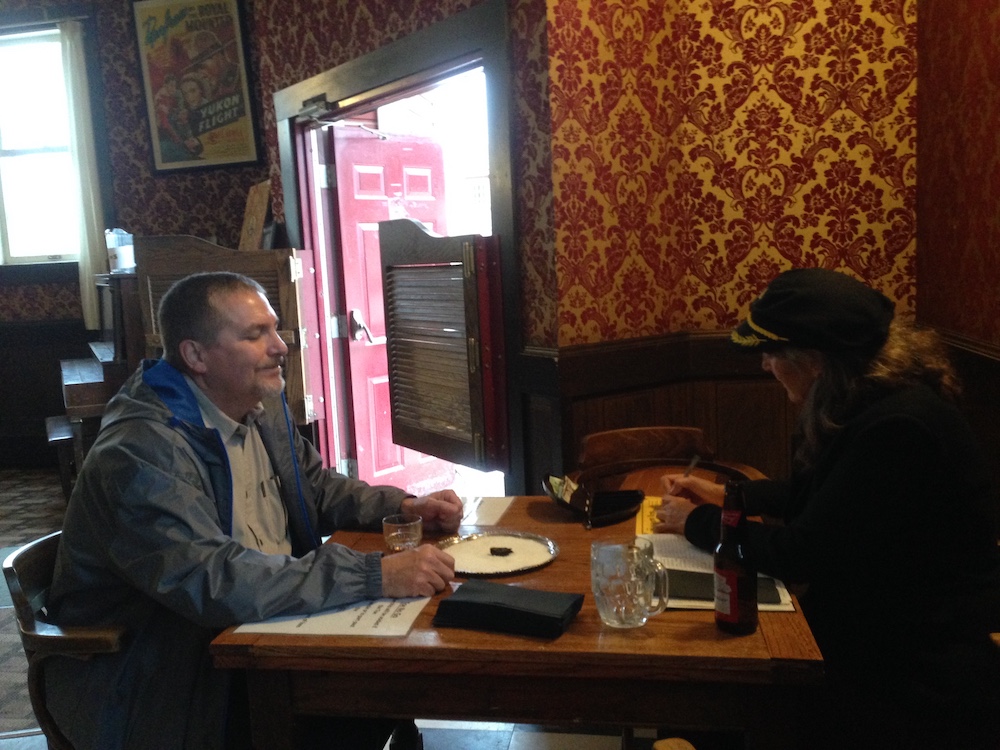
Preparing for the toe.
I ambled back to the table in the corner where Captain Dick’s representative, a mysterious woman named Bonnie who seemed to be part of everything that happened in Dawson City. She was a docent at one of the museums, a re-enactor at several locations around town and the keeper of the Sourtoe flame in Captain Dick’s eternal absence. I took my seat across from her and ponied up my sawbuck greenback and gazed upon THE TOE — a small, black thing about the size of an olive displayed on a paper towel on a silver plate in the center of the table.
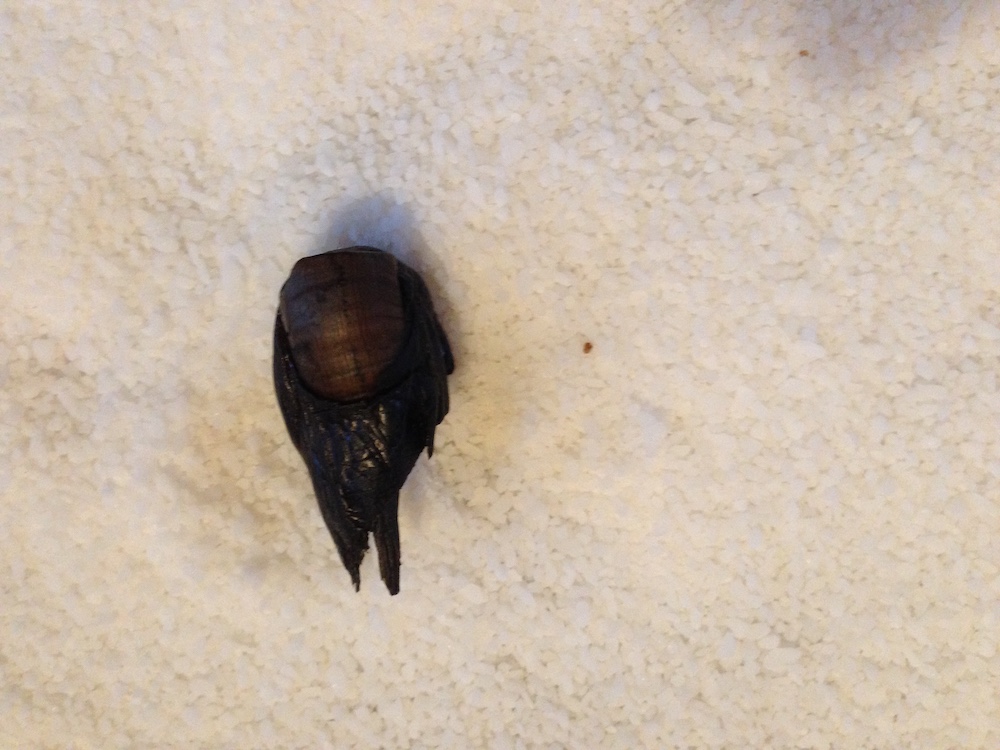
THE TOE
Bonnie then explained the rules of the cocktail:
1. The toe must be submerged in the liquor of one’s choice.
2. The toe must visibly touch the teeth when the cocktail was ingested.
3. If you swallowed the toe, you were subject to a $2,500 fine, enforceable by the sheriff.
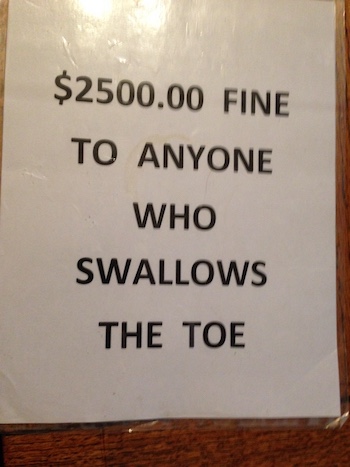
The fine for swallowing the toe originally was $100, which turned out to be an insufficient deterrent, and so began a gradual escalation of the penalty, which coincided with a growing scarcity of available toes, and their concurrent rise in both cost and value.
A note about the toe: Legend has it that the original toe had belonged to a miner who was losing his toe to gangrene due to frostbite and self-amputated it and preserved it in rum. Today, the toes are obtained from the local hospital, where they are de-veined, de-nailed and professionally preserved by trained medical personnel.
Now came the MOMENT OF TRUTH. Bonnie plucked the toe from the paper towel and plunked it down in my glass. I was encouraged to swirl it around for a minute or so, to infuse the liquid with the essence of the sourtoe. Then it was bottoms up, and the liquor flowed around my clenched teeth, the toe came to rest against my teeth, as confirmed by Bonnie, and then I spit it back into my now-empty glass.
I can’t tell you whether the toe had enfused the rye with any flavor, but I can tell you that the sensation of the toe against my teeth is one I’ll never forget.
Bonnie plucked the toe from my glass, plunked it into a waiting glass of Everclear grain alcohol to disinfect it, wiped it with a black paper napkin and plopped on the paper towel to await the next sucker.
Bonnie executed my Sourtoe Certficate, dated June 5, 2016, member number 64450, which certified that I was “a person capable of almost anything.”
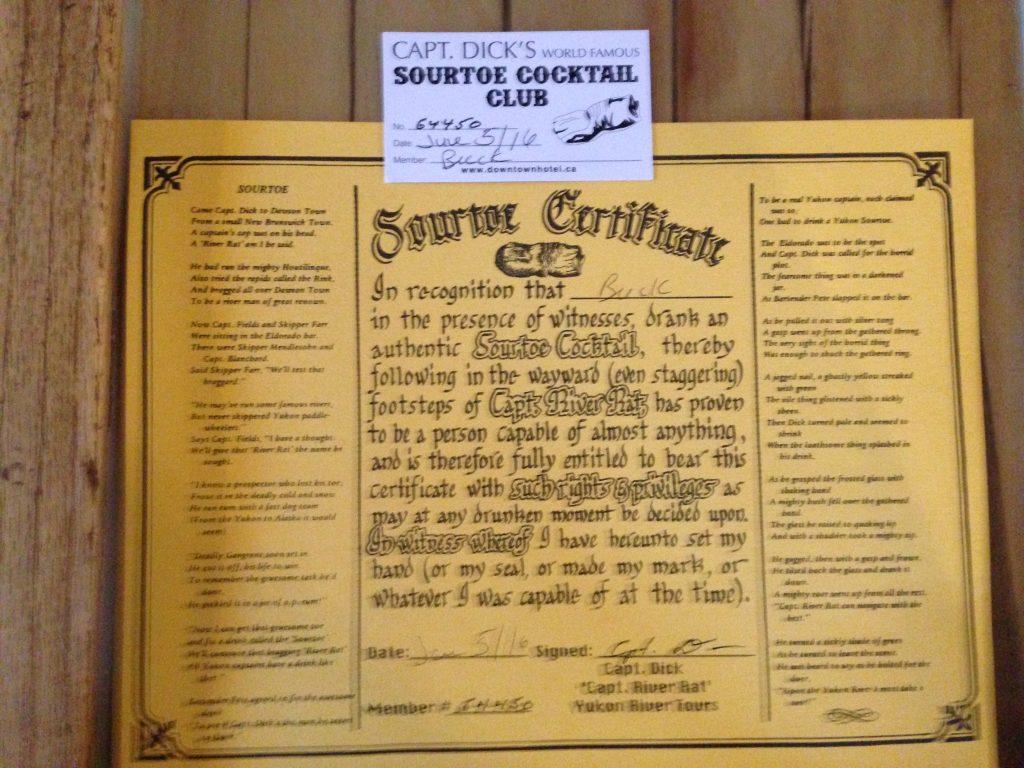
After a few celebratory rounds with my traveling companions, we burst forth from the Downtown Hotel into the bright light of the Yukon midnight, and indeed, I did feel capable of almost anything as well as a sort of communion with the 64,449 souls who had ingested Dawson City’s Sourtoe Cocktail before me.