The Making of an Editor
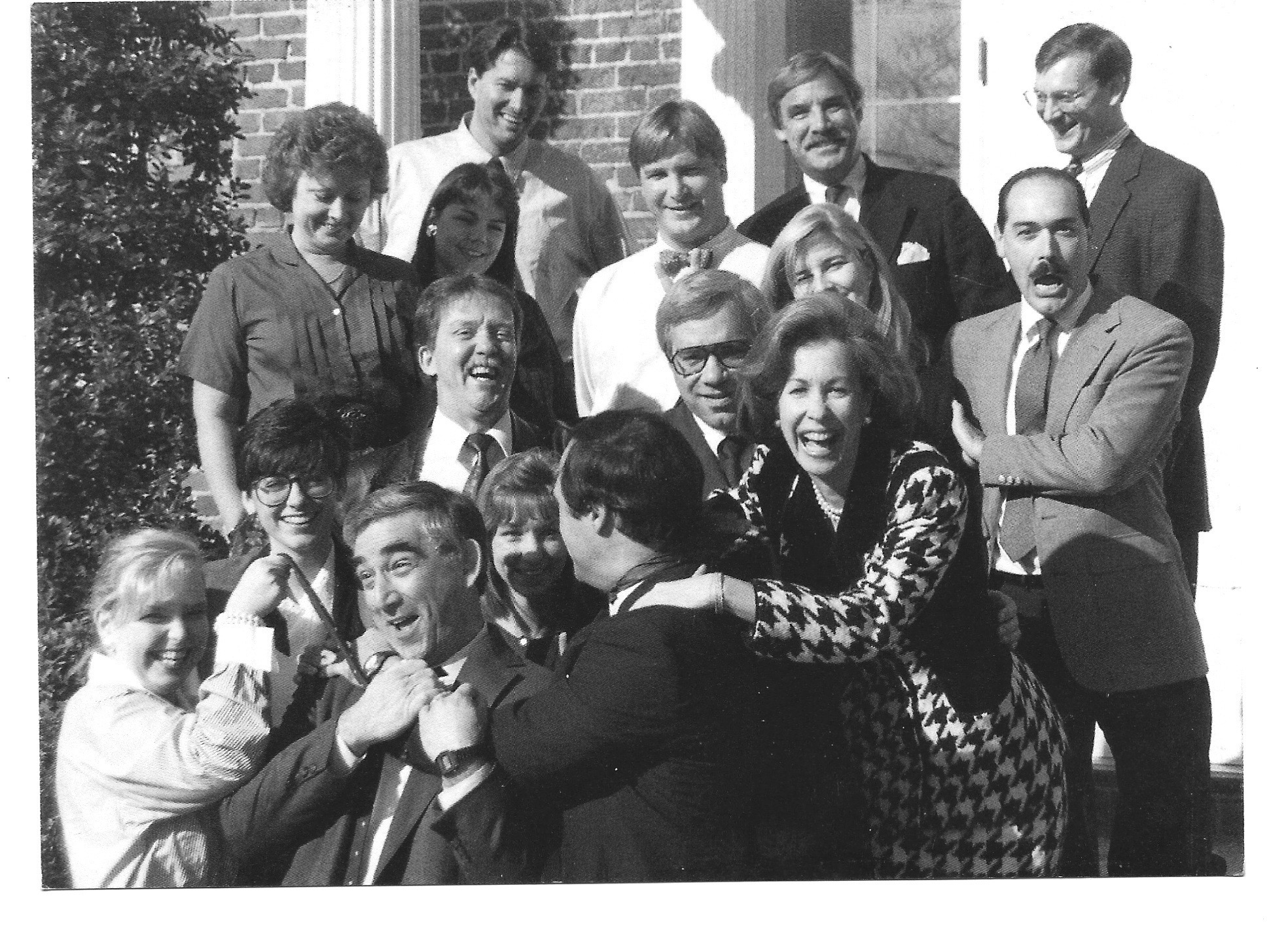
Pace Communications Xmas card circa 1990. Heartwarming seasonal message: ‘We’re constantly fighting to give you the best editorial product.’
In 1986 I finally left the plastics factory in Greensboro, N.C., after 6.5 years because I realized I needed to finish my undergraduate degree. My wife at the time, Terri Averette Banks, was art director at Pace Communications, a fledgling publisher of airline in-flight and business magazines. Terri had gotten me a gig demolishing some offices in the Pace building that were being remodeled. I was standing on top of a partition wall, busting up drywall with a sledgehammer when in walked Melinda Stovall with a shoebox in hand — and changed the trajectory of my life.
She coyly asked, “Would you be interested in a writing project?”
“Doing what?” I coyly replied.
“We’re starting up a new magazine called Southern Bride, and we need a directory of travel information,” she said, no longer coy.
“Sure,” I replied, jumping down from the top of the wall.
“Here,” Melinda said, handing me the shoebox. “Turn this stuff into a alphabetical listing of properties with a 30-word description and contact information. I need it in a week.”
I struggled to create the document using a manual typewriter, but I met the deadline. I then received a call from Melinda: “What do you think about learning to be a magazine editor?”
And so began a sort of boot camp of training with three of the smartest women I have known: Melinda Stovall, Mary Best and Sarah Lindsay. It was like having three merciless drill sergeants who were mercilessly endearing. I love them all to this day.
This was long before computers entered the picture, so the editorial process went (as best I can recall) something like this:
1. Writer submits manuscript of a contracted story typed double-spaced on bond paper.
2. We (the editors) copyedit the manuscript with each of us using a different color of pen, so we knew who did what. As the junior, I edited first, followed by the three women (a humiliating learning experience when I saw all that I had missed).
3. Edited manuscript is delivered via courier to the typesetter, who used a large mainframe computer to generate type.
4. The typesetter returns a galley copy (basically the manuscript as one continuous paragraph in the correct typeface for publication) along with the manuscript.
5. As the rookie, I was assigned the task of comparing the galley with the edited manuscript and marking up any additional corrections and paragraph breaks needed to make the galley jibe with the edited manuscript. Editors checked my edits.
6. The edited galley went back to the typesetter and a second galley produced.
7. A final round of editing went through four pairs of hands and a third typeset galley was provided that would be used for the actual layout and pasteup (using scissors, Exacto knives and literal paste) into magazine format.
8. That would be proofed again by all four editors and any edits would be made by the production staff by literally cutting and pasting.
9. The “final” version would be sent to the printer and a “blueline” created. This kind of looked like a dull blue mimeograph version of the actual publication, made using the actual printing plates. Changes at this point were costly, as they would require resetting the entire plate to fix something, so sometimes tough editorial decisions were required.
10. A member of the editorial staff or the art director was dispatched to the printer (always in some God-forsaken rural place in the South) to oversee the printing.
And that was how we made magazines in the Good Old Days.
I found the following document in my archives. It is a rundown of all the mistakes in one monthly edition of ASTA Agency Management, most likely written by Sarah Lindsay, considering the snark. The editor at the time was Mike Driscoll, who was notoriously immune to house style rules, which makes the footnote extra humorous. This helps explain how I made an entire 35-year career out of being anally retentive about a whole bunch of things nobody else really cared about.
Friendly Reminders about Unfriendly Usage from a Friendly Guy to his Friendly Peers Who Live Together with Him on this Friendly Planet
None of us is (are?) immune to error. That has been particularly evident in our copy-editing of page proofs, a fact brought to our attention by astute reader Buck Banks. To illustrate the point, here’s a few examples of what we collectively missed during the last round of copy-editing. The name of who missed what is given, not to point fingers, but to show that none of us is above reproach. Here goes:
• pullout, which appeared hyphenated in the table of contents and slipped by Mindy in that same state, is one word when used as a noun (or adjective), according to AP and Webster’s (however, Mindy was able to later point out to Buck, who had pointed out the error to her, that he had spelled pullout two different ways in his Cruise Case Study story — c’est la vie)
• mom and pop, which appeared hyphenated on a second run in the Flight Patterns story and damn near went to print that way, is never hyphenated, according to the Webster’s entry under that heading
• backup, which appeared as two words in the Flight Patterns story and was missed by both Alice and me, is one word as a noun or
adjective, according to our friends at AP• the States, when referring to the United States and which Buck lower-cased in copy-editing the safari story, is capped, according
to the Webster’s entry under states• semimonthly, which Mindy hyphenated in her Successful Agent story and failed to catch on her first proofing of that story, needs no hyphen, according to AP
• antimalarial, which appeared in the safaris story, is a good example of how we feel compelled to hyphenate words every time we have a prefix. It’s one word, says Webster’s. So is potholes and propjets, both of which appeared in that same story. And strenous, which made its debut in a subhead in that story, only makes sense to the English-speaking world when it has an additional “u” inserted after the “n”
• reissue, which appeared hyphenated in the cover story, is one word, say our friends at Webster’s
• Delta Air Lines is three words, not two, according to the people who gave it that name
(Footnote 1) except our esteemed editor, whose correlation between our jobs and his influence on them prohibits us from pointing out any copy-editing errors he may be guilty of.
PS. Not that he makes any mistakes anyway
• A.D. 60, a year that appeared in the ASTA International story, should appear in print just that way, not transposed (60 A.D.) as Alice thought it might should be on her copy-edit of that piece
• phone numbers, according to our house-style sheet, don’t require hyphens around the area code as was the case in Inside
TrackThere are many more examples. All of us are guilty. The important thing to remember is to approach copy-editing with a dose of humility. In the words of Lawrence J. Frommer: Correct usage comes not by assuming that you know it all, but by turning pages, first in our house-style sheet (which B2, who penned the phrase, “Question everything, assume nothing,” is revamping and revising), the AP Stylebook, then Webster’s New World Dictionary Third College Edition.
We thank you for your cooperation and for your unwavering devotion to make ASTA Agency Management the best gosh darn magazine in the world.