Untangling ‘Entanglement’: A Conversation About the Creative Life with George McDonald
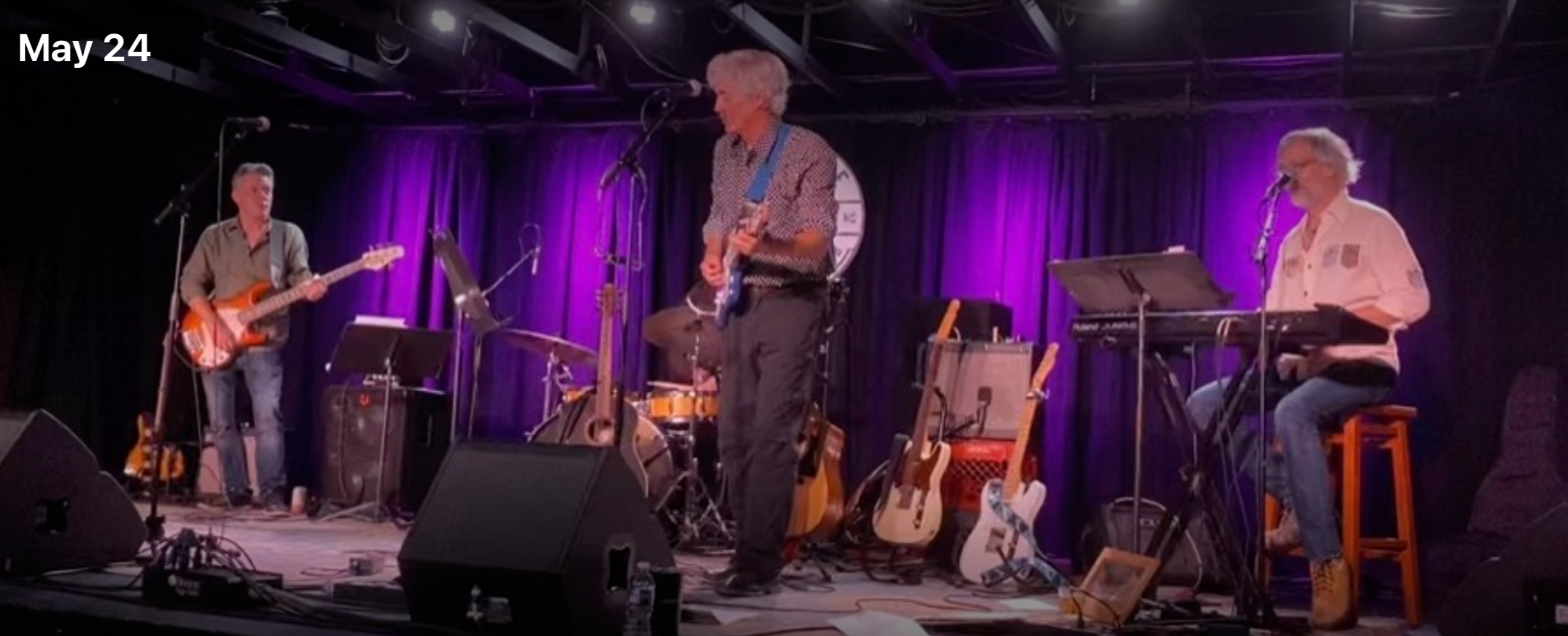
George McDonald, who performs under the alias “George Trouble,” can’t separate his creative life into neat categories.
For years, people told him he should. Some insisted he devote himself to music. Others said he should concentrate on painting. It seemed like practical advice. Success, they argued, usually comes to artists who choose one path and follow it relentlessly.
George never seemed interested in making that choice. Indeed, he doesn’t seem to recognize it as a choice.
Instead, he has spent decades writing songs and making records while building a substantial body of visual art under his given name, George Terry McDonald. The songs and the paintings emerged side by side, intertwined — entangled — as it were. While one canvas dries, another song begins to take shape. While writing lyrics, an image from the studio inhabits the music. To George, they’re simply different avenues of exploring the same questions.
His latest studio album, “Entanglement,” recorded with his longtime band The Zealots, may be the clearest expression of his way of creating.
I’ve known George for over forty years. We became friends long ago, and we’re still talking about songwriting, painting, books, religion, politics, and the mysteries of the universe.
“Entanglement” was released July 10. George and I spoke in late May the day after a Zealots album-release gig at the Grey Eagle in Asheville, N.C., where George interspersed songs from the new album with classic Bob Dylan tunes, in celebration of the singer/songwriter’s 85th birthday.
In Asheville, one meets either at a brewery or a coffee shop. We opted for a sunny coffee shop patio.
The conversation wandered — as conversations between old friends will. We talked about Bob Dylan, Elvis Costello, quantum physics, Hank Williams, painting, Wordsworth, religion, and the increasingly complicated business of making art in America. It became an exploration of the creative life George lives.
Not the one other people imagined for him. The one he made for himself. On his terms.
I asked how many songs he’s written, “I don’t play them all anymore.,” he said, laughing, “But altogether, probably around a hundred.”
He first started writing songs in the 1980s while living In Chapel Hill, N.C.
“The first one was a pretty lousy song that I don’t play anymore because it really wasn’t very good,” said George. “The first song I ever recorded was with Don Dixon. It was the original version of ‘The Clinic-O.’” He still plays that song live.
As far as musical influences, George says they include his friends, “the people whose conversations I steal from. As far as musicians, the obvious influences are Bob Dylan, the Beatles, and the Rolling Stones. Then Elvis Costello, XTC, Bruce Springsteen, and, to some extent, Talking Heads.
“Later on, Gram Parsons became a huge influence. Certainly Hank Williams, too — all the great songwriters. Maybe I had too much Puritan indoctrination to write nothing but silly or self-indulgent songs.
“Now, I’ve certainly written silly and self-indulgent songs,” he chuckled, “and I’ll probably write some more.”
Country, Punk and Everything in Between
I told him “You Dressed Me Up,” from the album “Plow” was one of my favorites and a great example of one of his songs that was both catchy and funny.
“That one is definitely about self-indulgence,” George admitted.
On the “Plow” album, the first side explores different Americana and country musical stylings, and then suddenly Side Two propels you into post-punk and rockabilly.
“That was kind of the point,” said George. “A song is a song. You can do it as country or you can do it as hard punk, and it’s still the same song.”
Untangling ‘Entanglement’
George’s albums usually have one-word titles: “Plow,” “Jawbone,” “Entanglement.” I asked him where the latest title came from.
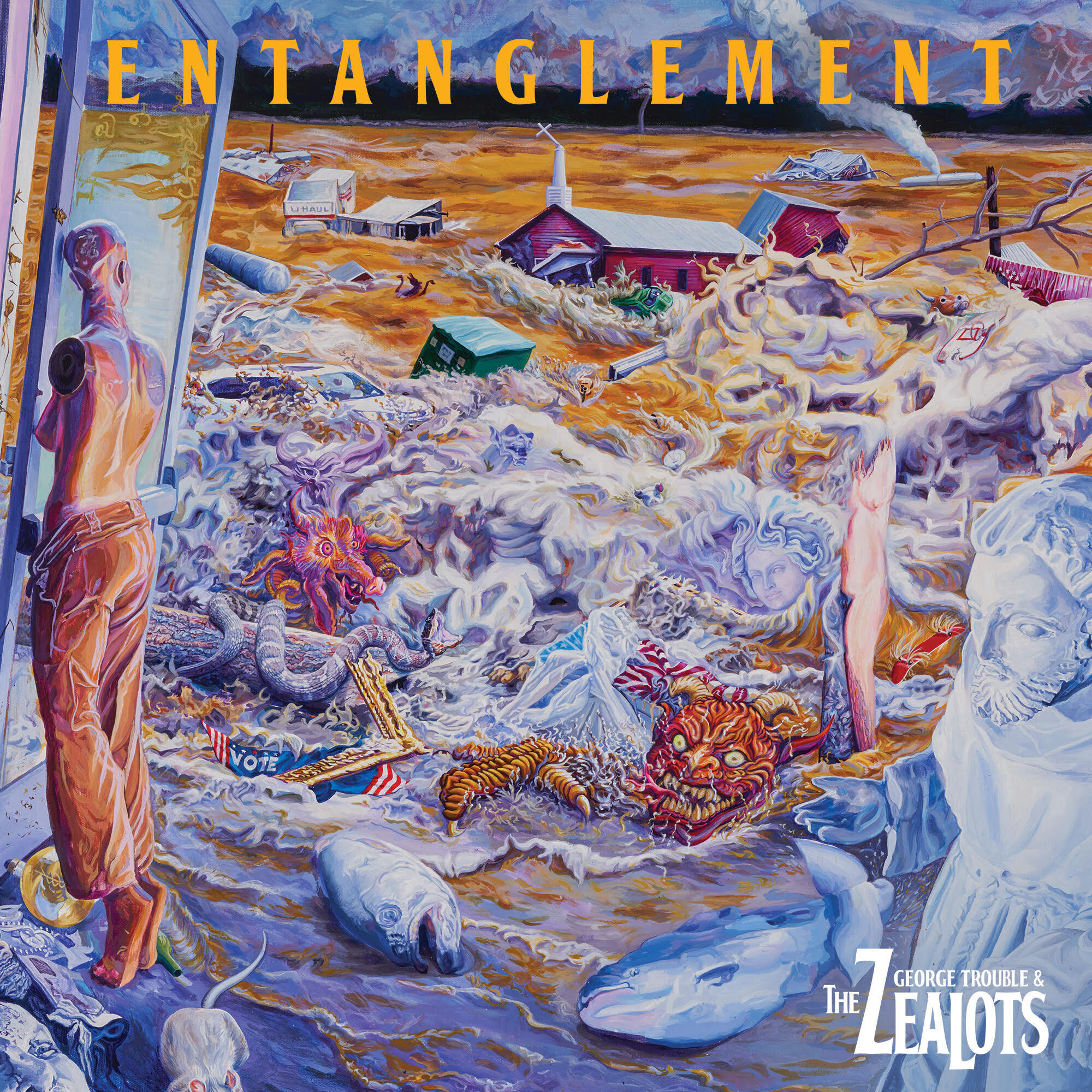
‘Entanglement’ album cover illustrates the aftermath of Hurricane Helene
“I hope this doesn’t sound pretentious. When I’m painting, I usually have YouTube playing in the background. If you don’t pay for it, the YouTube algorithm just keeps feeding you similar things.
“A few years ago, YouTube started sending me Neil deGrasse Tyson. That led to Brian Greene and the World Science Festival. Pretty soon I’m listening to people explain quantum physics and quantum entanglement while I’m standing in front of a canvas.
“The funny part is, I don’t really understand most of it, but I love listening to it.
“Somewhere along the way I realized that even if I couldn’t explain the science, I understood why the idea fascinated me. The notion that things separated by enormous distances could somehow remain connected … That’s poetic. Quantum physics is poetic science.”
George said he doesn’t know whether any of the songs on “Entanglement” are literally about quantum theory.
“Probably not,” he concedes. “But I do think they’re about those moments Wordsworth described as ‘intimations of immortality.’ I’ve been talking about transcendence ever since you and I met. Emerson. Wordsworth. All of it.
“Of course, back then we were usually discussing those ideas in … less than sober circumstances.”
George admits that chemicals have played a role — positive and negative — in his growth as an artist and his understanding of and relationship to reality.
“Psilocybin genuinely changed my awareness in positive ways,” he said. “I can’t really say that about most of the other drugs. There are regrets, no question. But I’m also grateful that somehow I managed to lift the cloak of Calvinism from my eyes. It was a destructive way to get there, but it happened.”
George carps a lot about having to shrug off his Calvinistic Carolina upbringing, but that doesn’t mean he’s not spiritual.
“I’m not hostile toward religion,” he said. “I just want things to feel believable. Not completely delusional. Because … in many ways … we were raised inside a delusion.”
Playing the Room
George doesn’t build a set list by rote. Every performance begins with a field study.
He walks into a gig space — a brewery, a listening room, or a neighborhood bar — and he takes inventory, not of the stage setup or the sound system, but of the audience.
“You do a demographic study,” said George. “If it’s a bunch of country guys drinking Budweiser, I might pull out ‘El Paso.’ If they’re hipsters, maybe a Wilco song. I always carry lyric sheets because you never know who’s going to walk through the door.”
The balancing act goes deeper than choosing covers. George constantly wrestles with how much of his original music an unfamiliar audience is willing to hear.
“I’d much rather play places where I can go fully into what I feel like singing that day. But there are places where I just can’t get away with it and get hired back.”
That’s the reality of life as a working musician: every set is a negotiation between artistic freedom and economic survival.
Where the Songs Begin
Asked how he writes, George doesn’t describe formulas or notebooks full of lyrics.
Sometimes a melody arrives first.
Sometimes it’s a phrase.
Sometimes it’s simply an idea that refuses to leave his head.
Lately, he says, he’s become interested in writing songs that invite listeners in rather than challenge them to keep up.
“I want to use my songwriting ability to relate rather than turn people off or make it difficult for them to listen,” he said.
That doesn’t mean abandoning complexity. It means finding it in ordinary life — in car repairs, relationships, work, aging, and the daily compromises everyone makes.
As he talks about songwriting, another theme emerges: George no longer believes the creative process has to be a struggle.
“I want to get to where I’m able to enjoy the experience and have it happen without so much laborious ponderousness.”
On the Horizon
So, what does he see as the future of the Zealots and his music? George says the practicalities and logistics of performing make the road ahead seem daunting, but also full of potential.
“Well, the cold hard facts are, now because of tariffs and war, even traveling, it’s going to be difficult to break even,” he said. “But I’m going to do it as much as I can do it, to get some sort of awareness of my stuff out there, wherever people are willing to actually listen.
“I’m talking about making better recordings that have some of the ear candy that we all agree is classic and will continue to be good, whether it’s grunge or ska or pop,” said George. “If it’s good, it’s good, like Duke Ellington said. I have the desire to keep writing good songs and making good recordings, but it’s not going to be sustainable if I can’t make some money playing music. And the only way I see that happening is as a solo act, at least for the time being.”
But he’s keeping watch for that big break: “Now what would be really cool is if I could write a song about getting a new car and General Motors pays me to use the song.”
Hey, GM, you listening?
NOTE: “Entanglement” is available for download on all major streaming services, but if you buy it on Bandcamp, the artist receives 80% of the money.